Our Environmental Management System
Advancing Our Sustainability Priorities
Our global environmental management system (EMS) reflects our unwavering focus on excellence and continuous improvement in our sustainability program. Serving as the backbone of our environmental strategy, the EMS integrates our sustainability goals with a comprehensive approach to managing environmental impacts and risks, addressing stakeholder needs, enabling transparent measurement and reporting, guiding leadership and governance, promoting operational best practices, identifying opportunities for improvement, and driving sustainability projects and programs.
Our EMS has been independently verified as compliant with the ISO 14001:2015 standard. To meet and exceed the standard’s requirements, we have developed robust internal systems for tracking, monitoring, measuring, and reporting, tailored to Akamai’s unique operations and designed to support the continuous evolution of our EMS. These tools empower teams across the company to collaboratively drive progress toward environmental objectives while delivering transparency and actionable insights into the company’s environmental performance.
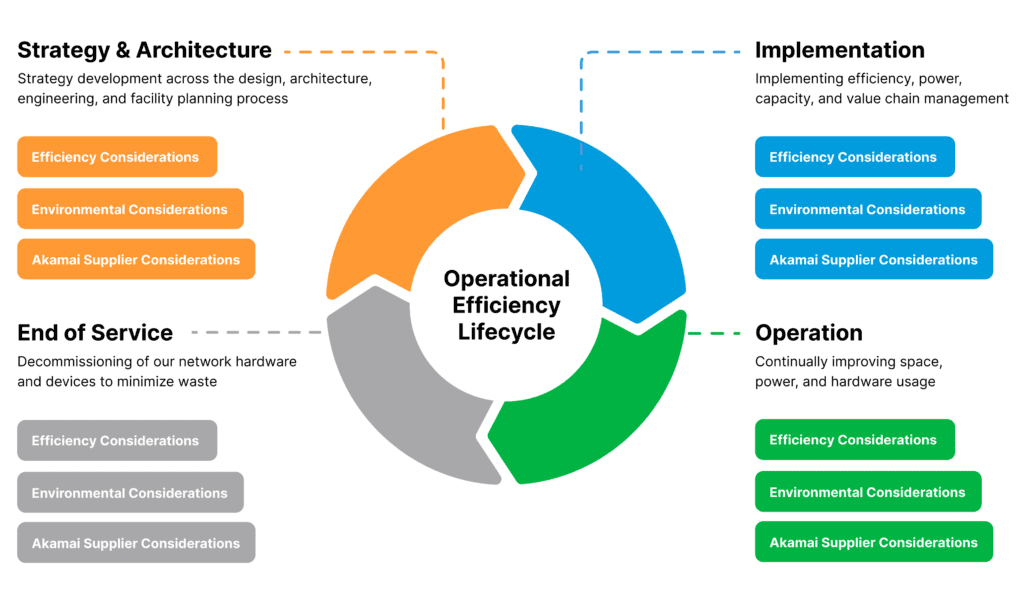
The scope of our EMS covers environmental management of Akamai’s operational efficiency lifecycle, including strategy & architecture, implementation, operational improvement, and end of service — across data center and office facilities, physical hardware, software, network, capacity, and value chain contributing to greenhouse gas emissions output across scope 1, 2, and 3. This includes areas beyond our direct operational control and encompasses all of Akamai’s global activities across our value chain.
Developing our EMS in compliance with ISO 14001 was a complex endeavor. Although the ISO standard is designed for application by any organization, we encountered unique challenges given our focus on building, delivering, and securing digital experiences rather than physical goods. To overcome these challenges and build an efficient EMS, we leveraged creativity and innovation to create a system that comprehensively addresses our environmental impact.
The independent audit process for attestation involved thorough evaluations of our EMS processes and site audits to verify EMS effectiveness from our headquarters to the edge. This multiyear effort led to significant improvements and culminated in our initial statement of attestation in 2024. Going forward, we will continue to undergo an annual independent audit process to maintain our ISO 14001 compliance and attestation. Within the framework of the ISO 14001 standard and the ongoing compliance audit process, we continue to challenge the status quo, using pioneering approaches to uncover and address continuous improvement opportunities across the full scope of our EMS.
Akamai ISO 14001 Attestation Statement 2025–20264
Our work doesn’t end here. Building a robust EMS is challenging but necessary to pursue our goals rigorously. We are prioritizing the continual improvement of our EMS and reducing our environmental footprint across our global platform. We actively seek opportunities to collaborate with internal and external partners to empower sustainable improvements and deliver on Akamai’s sustainability mission of harnessing the power of our global platform to create a sustainable and equitable future for the world.
4 Given that our operations reside primarily in colocation spaces that we do not own, we were encouraged by our verification provider to pursue ISO 14001 group attestation rather than certification. The certification is stringent, while group attestation allowed us to cover the entirety of our operations within the scope of our EMS, rather than only our limited owned and directly controlled physical footprint.