Operating in Colocation Spaces
Net-Zero Emissions
We take a comprehensive approach to understanding our emissions footprint. Like many companies in the IT Software and Services space, our colocation data center footprint constitutes a significant portion of our global operations.
Our sustainability program focuses on addressing energy consumption and emissions across our infrastructure, both direct and indirect. This includes energy use from owned generators, cooling equipment, and IT equipment in data centers. Our 2030 sustainability goals underscore our aspirations, targeting net-zero emissions and 100% renewable energy for our global platform. To achieve this, we collaborate closely with our colocation partners to advocate for the procurement of high-quality renewable and clean energy attributes.
While we prioritize reducing emissions within our direct operational control, we recognize the importance of critical services in colocation data centers, including cooling, lighting, and uninterruptible power supplies (UPS). These services contribute significantly to overall energy use, often reflected in metrics such as Power Usage Effectiveness (PUE). While contractual terms with vendors may limit our ability to directly influence utility energy mix, site efficiency, and PUE metrics we remain engaged in working collaboratively with our partners. Our efforts are focused on addressing energy consumption and emissions associated with colocation operations and PUE, in alignment with our 2030 sustainability objectives.
As we advance, we remain steadfast in our approach to further decarbonizing our services and expanding our focus to address broader impacts across our value chain, driving progress toward a net-zero future.
Our 2024 Approach to Operational Emissions Accounting
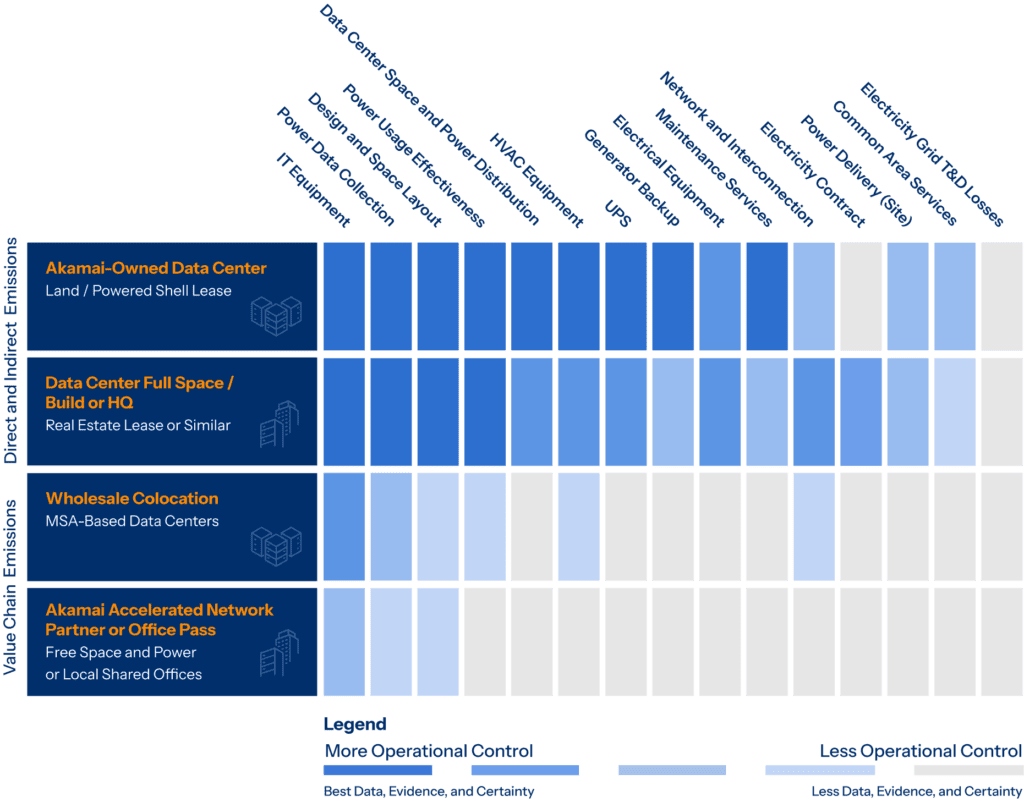
Standardizing GHG Accounting in Colocation Spaces
In 2025, Akamai will continue to partner with our colocation service providers to establish standardized accounting and reporting practices for emissions disclosures in our data center locations. Standardized emissions accounting that provides an approach to consequential traceability is crucial to ensuring accurate and consistent reporting, preventing issues such as double-counting or failing to report emissions values entirely due to assumptions that either providers or customers have accounted for. This effort is particularly critical as data center power demands continue to grow, amplifying the need for clarity and alignment in emissions reporting.
What are the Key Objectives?
- Ensuring our partners prepare GHG inventories that represent a true and fair account of their emissions by using standardized approaches and principles.
- Increasing consistency and transparency in GHG accounting and reporting across organizations and programs.3
Despite these objectives, Akamai, as a global customer of colocation services, frequently encounters significant variations in how colocation providers interpret and implement the current Greenhouse Gas Protocol (GHGP), the primary accounting guidance used by most companies today.
Even among providers with similar contract structures and power delivery models, reporting practices differ considerably. This variability in reporting practices poses challenges to the goal of standardizing GHG accounting, making it more difficult to track emissions accurately and achieve seamless industry-wide comparability. While the GHGP offers a valuable foundation, it can be challenging for global companies to derive consistent and actionable data across jurisdictions.
Key Challenges in Emissions Reporting
A central challenge in GHG emissions reporting for colocation services lies in determining which party is responsible for reporting specific emissions and under what boundary. In particular:
- Indirect Energy Emissions Reporting: Some colocation providers include all emissions from energy consumed within their data centers as indirect emissions, encompassing power used by their customers.
- Indirect Energy Emissions vs. Value Chain Emissions: Other providers only account for emissions related to their infrastructure as indirect energy emissions, leaving customer-related emissions unaccounted for or assumed to fall under value chain emissions.
- Common Areas Only: A few providers report only the emissions associated with ancillary power used in shared or common areas, such as lighting or cooling, creating further inconsistencies.
Variations in reporting frameworks can lead to challenges for both customers and providers in achieving clarity and consistency, potentially impacting the accuracy and reliability of emissions data and alignment with global sustainability goals. Establishing clear standards would effectively minimize the risk of misreporting or omissions, fostering greater trust and transparency in GHG disclosures.
Akamai’s Approach to Clarifying Accountability
To address these issues, Akamai is aligned on clarifying the interpretation of operational control in colocation spaces. This approach will assign emissions responsibility based on operational authority, which governs the activities and decisions impacting emissions. We aim to to work across the industry to establish clearer boundaries for:
Provider Responsibility
Emissions associated with the provider’s infrastructure, including building operations, cooling systems, and power delivery infrastructure.
Customer Responsibility
Emissions tied to customer usage of colocation space, such as the energy powering servers.
Data Transparency
Ensuring providers consistently share accurate and granular energy and emissions data with customers to support transparent reporting and informed decision-making.
Moving Toward Industry Alignment
Akamai is supportive in fostering collaboration between colocation service providers and their customers to establish clear and consistent accounting practices. By working together to standardize the various approaches, we can enhance the accuracy of emissions reporting and unlock broader opportunities for meaningful decarbonization. Addressing reporting challenges will enable the data center colocation industry to focus on driving impactful initiatives, such as:
- Expanding investments in renewable energy generation
- Advancing clean energy procurement strategies
- Innovating in energy efficiency and operational sustainability
Through these collective efforts, we strive to bridge gaps in emissions reporting, provide more granularity through our accounting, and inspire progress by promoting transparency and accountability across the colocation and data center ecosystem. We believe working together as partners, we can help lead the way toward a more sustainable future.
Incorporating Best Practices with CEBA
In partnership with CEBA, we have prioritized integrating environmental considerations into the strategic planning process for our global platform. Through our participation in CEBA, Akamai helped to create a guide of best practices for corporate colocation and cloud procurement, and calls for our colocation providers to follow the same principles. As a signatory of the Corporate Colocation and Cloud Buyers’ Principles, Akamai supports the following goals:
Options
Provide options for cost-competitive services powered by renewable resources that reduce emissions beyond business as usual.
Data
Deliver monthly data on the colocation customer’s direct and indirect energy consumption, water consumption, greenhouse gas emissions, and other environmental data.
Incentives
Align the partnership between customer and service provider, so both parties have an incentive to reduce energy consumption.
Collaboration
Provide options for customer collaboration on efficiency and renewable energy enhancements.
Disclosure
Disclose data for individual sites and total global corporate footprint, as well as site-specific energy sources.
Advocacy
Engage in policy advocacy efforts that support the use of renewable energy.
Helping to ensure our colocation and cloud service providers support these principles will help not only Akamai, but also other companies using their services, to meet sustainability goals.
3 Both objectives are foundational principles derived from the Greenhouse Gas Protocol (GHGP).