Developing Hardware Efficiencies
Build Efficiency
Akamai’s server fleet is a cornerstone of our network, ensuring security, speed, and reliability for customers worldwide. This study set out to answer a key question: Have our server generations become more efficient over time?
To explore this, we analyzed real-time data snapshots from two primary types of production network servers. For clarity, we refer to these as our Encryption-Focused (EF) and Data Transfer Optimized (DTO) networks. Each server type plays a distinct role within our infrastructure:
- EF servers perform intensive cryptographic computations, consuming more CPU and power per megabit of data output.
- DTO servers operate with fewer computational overheads, offering another perspective on efficiency.
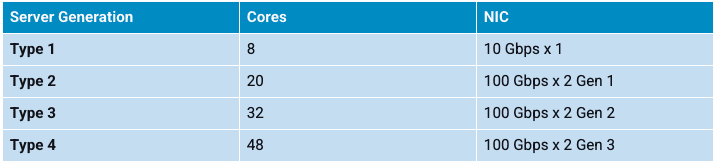
The study focused on four of Akamai’s latest server generations — for simplicity purposes, we will call these servers “type 1 through 4” — looking specifically at two key efficiency metrics:
- Megabits per second per watt — a classic measure of power efficiency.
- Megabits per second per watt per % CPU in use — an enhanced metric factoring in CPU utilization, offering a clearer view of real-world efficiency under varying workloads.
Server Generations at a Glance
Each server generation was evaluated based on its technical specifications, including CPU type, core count, and network interface card (NIC).
Methodology: Capturing Peak Efficiency
To ensure robust results, we analyzed server performance during peak usage hours — 7 PM to 10 PM local time in their respective regions. Real-time data from our global data collection system and multiple metrics provided insights into power consumption and CPU activity.
Key adjustments
- Type 1 power correction: Type 1 servers report a single power value per chassis, which houses two servers. For accuracy, power consumption was halved per server
Findings: Generational Efficiency Trends
Using the enhanced metric (megabits per second per watt per % CPU in use), our analysis revealed:
- Efficiency Increases Across Generations: Each new server generation consistently outperformed its predecessor, and our latest generation shows the highest efficiency values across both networks.
Encryption-Focused and Data Transfer–Optimized Insights
- EF: Servers demonstrated lower efficiency due to their cryptographic demands. However, even within this group, generational improvements were clear.
- DTO: Servers followed the same trend, benefiting from lower computational overhead.
Efficiency Gains at a Glance

Implications for Server Deployment
While Type 4 servers are the most efficient when fully utilized, idle cores still consume significant power. This highlights the importance of aligning workload allocation with available core capacity, especially for Type 4 servers, to optimize power usage.
Conclusion: A Clear Efficiency Progression
The study confirmed that Akamai’s server generations have consistently increased in efficiency, with each iteration delivering significant improvements. Type 4 servers lead the fleet, underscoring Akamai’s dedication to innovation and sustainability in powering the internet. However, future operational strategies should prioritize load balancing to maximize the potential of these cutting-edge servers.
This ongoing focus on efficiency reinforces Akamai’s position as a leader in sustainable technology, ensuring our network meets the evolving demands of a connected world.